Sunday, May 29, 2011

The Farm Economy

            
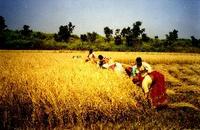
If life gives you an opportunity to help a farmer, then do not shy away, coz he is the one who brings food to our table.India can become a global power if we were to have 44% of our nation engaged in agriculture with the rest split in manufacturing and services sector respectively. The challenge is not only to wean 10% off the agriculture successfully and absorb them in manufacturing/services sector within the rural sector, but also to ensure that the remaining 44% of Indian agriculturist are able to produce more food grains and other natural products.


India had been a self sufficient nation for centuries where the village was a self sustaining entity with its own cultural identity. God blessed us with fertile lands and intellecutally capable people till the 17th century.Then came the colonial rule of India, a dark part of our history. The rule of British on India was unfortunate in a lot of ways like  the systematic destruction of grass root village economy brought the Indian village economy to bankruptcy.


50 years and more of freedom, we've had some achievements like that of the green revolution courtesy scientists like M.S. Swaminathan, however, we still have 54% of Indian citizens engaged in agriculture contributing only 29% to the GDP of India. We need more scientific innovation and growth in low cost agricultural technologies that would contribute to the self sustenance and competitive edge of Indian agriculturists. It is important to note that we're talking abour more than half of the country that is engaged in agriculture( 54% ) with a majority of farmers having small land holdings making large scale farming techniques irrelevant to most Indian farmers.

Thursday, May 26, 2011

आठवें फेरे का वचन

 बेटियों को बेटों से हीन समझने वाली रूढ़ीवादी सोच को युवा ही बदल सकते हैं, बेटी को बोझ मानने की मानसिकता को बदला जाए और बेटी के जन्म पर भी ख़ुशी का इज़हार किया जाए

गांव के घर में क़दम रखा तो थाली को चम्मच से बजाने की आवाज़ आई.
सत्यवान की बेटी हुई है और उनकी मां थाली बजा कर इसकी मुनादी कर रहीं हैं.
घर का आंगन खचाखच भरा है, बच्चे, बूढ़े, जवान, पूरा गांव जुटा है.
फिर ख़ास पीली और लाल रंगों की चुनरी ओढ़े सत्यवान की पत्नी, मुन्नी अपने कमरे से बाहर आईं और अपनी बेटी दिव्या को गोद में ले लिया
इस गांव में रहने वाले जाट समुदाय में बेटे के जन्म पर मां को डेढ़ महीने तक घर में आराम करने दिया जाता है लेकिन बेटी के जन्म पर दूसरे दिन ही घर के काम पर लगना पड़ता है.
पर दिव्या के जन्म के बाद उसकी मां को तीन हफ्ते तक आराम करने दिया गया.
दिव्या की बुआ के बाद इस परिवार में 36 साल बाद फिर बेटी हुई है. गांव की सभी महिलाएं अपना मुंह ढांपें ये सब देख रही हैं. लेकिन उनकी आंखों में हैरत और अविश्वास साफ़ झलक रहा है.
कुछ आंखें नम भी हैं. खास तौर पर बुज़ुर्ग महिलाओं की, जिनकी ज़िन्दगी का सच कुछ और ही रहा है
शुरू करती हैं, तो कुछ उनपर थिरकना.

22 साल की मोनिका बहुत झूम के नाचती है, मानो जश्न उसके पैदा होने पर मनाया जा रहा हो. मोनिका कॉलेज में है और एम.ए. कर रही है.
मोनिका भी कुछ ऐसा करने वाली है जो यहां कभी नहीं हुआ. अगले महीने उसकी शादी है. अपनी शादी पर वो सात की जगह आठ फेरे लेगी.
आठवें फेरे में वो अपने पति के साथ वचन लेगी कि कभी भी गर्भ में लिंग जांच करवा बेटी को नहीं मारेंगे 

Tuesday, May 24, 2011

Kabir


Six hundred years ago Kabir was born in India in 1398 AD. He lived for 120 years and is said to have relinquished his body in 1518. This period is also said to be the beginning of Bhakti Movement in India.

A weaver by profession, Kabir ranks among the world's greatest poets. Back home in India, he is perhaps the most quoted author. The Holy Guru Granth Sahib contains over 500 verses by Kabir. The Sikh community in particular and others who follow the Holy Granth, hold Kabir in the same reverence as the other ten Gurus.

Kabir openly criticized all sects and gave a new direction to the Indian philosophy. This is due to his straight forward approach that has a universal appeal. It is for this reason that Kabir is held in high esteem all over the world. To call Kabir a universal Guru is not an over exaggeration. the simplicity of Kabir's poetry

The hall mark of Kabir's poetry is that he conveys in his two line poems (Doha), what others may not be able to do in many pages.Another beauty of Kabir's poetry is that he picks up situations that surround our daily lives. Thus, even today, Kabir's poetry is relevant and helpful in guiding and regulating our lives, in both social and spiritual context.


Looking at the grinding stones,
Kabir laments
In the duel of wheels,
Nothing stays intact. 


Monday, May 23, 2011

The both sides.


They breathe fresh air which promotes their health. They also get pure ghee and milk. There is no hustle and bustle and no worry as in the modern life. The villagers, therefore, are happy and healthy. They lead a simple life and their desires are few. They are satisfied with what they have and never dream of those luxuries and comforts that modern science has provided us with in such ample measure.

The villagers are socially knit together. Their life is co-operate and interdependent. They depend on each other for the supply of their daily wants. They share in the joys and sorrow of each other. They help each other in time of need. Their social sense is so strong that the guest of one is considered as the guest of all. In a town or city, one does not care to know even one's neighbour. But each villages is familiar with the family history of other villagers. In the evening they assemble in the village "Chopal" with there 'hukkas' and chatting and talking goes on till late the night.This is their simple recreation.
On the contrary....
In Shahabad and Kishanganj panchayat samitis of Baran district, declared as sahariya region by the State Government. Sahariya's live in infrastructurally weak and remote areas not connected through road/bridge network. Other local communities like Maali, Kirads and mostly Bhil tribals. The communities love to stay in mud house and they have lack of exposure to modern life. Their primitive habits have lead to historic exploitation by local landlords. Superficial support extended through govt subsidyto them has, in most cases been wasted in booze rather than strengthening their agricultural resources or productivity


Tradition, caste rigidities and religion are usually cited as obstacles to development. It's quite clear that the villagers are extremely conservative; but it's less clear that these are direct obstacles. The villagers seem aware that caste rigidities do more harm than good and that these must be set aside if they are to improve their lives.
Education and literacy are often assumed to be answers to rural under-development. Certainly, the young seem ready to accept the implications of education and seek work outside the village.


Saturday, May 21, 2011

Legendry leader who dreamed to lead us to 21st Century


http://static.guim.co.uk/Guardian/world/gallery/2007/may/09/india/HU056298-5036.jpg
http://www.nutquote.com/thumb/5509-Rajiv_Gandhi.jpgRajiv Gandhi would have been 66 years old  had he lived. He was only 46 years old when he was targeted by a human bomber and killed in the most gruesome manner in Sriperumbudur in Tamil Nadu at a meeting venue, which was not there on his original schedule.
But destiny had other things in store and India’s youngest Prime minister(he was only 40 when he became the PM) died with an unfinished agenda.
The man who brought India on the global cyber map and for whom the dream was to take his country to the 21-st century left much before he could complete his mission. On top of it he had to suffer the humiliation of being accused in the Bofors bribery case. The High Court finally exonerated him some years ago. His widow Sonia Gandhi and son, Rahul who are determined to complete the pending work, are now carrying on his legacy.

son of Indira Gandhi, was the seventh Prime Minister of India from his mother’s death on October 31, 1984 until his resignation on December 2, 1989 following general election defeat. Rajiv was chosen as prime minister by the party leadership within hours of his mother’s assassination. He served as the Prime Minister of India from 1984 to 1989.
Rajiv Gandhi was the one of the dynamic indian prime minster.http://photogallery.indiatimes.com/news/india/remembering-rajiv-gandhi/Remembering-Rajiv-Gandhi/photo/4561473/Remembering-Rajiv-Gandhi.jpg
“I too have a dream. I dream of an India – strong, Independent, self reliant and in the front rank of the nations of the world in the service of mankind.”

Bharat Ratna Rajiv Gandhi India’s late Prime Minister 
said these words once and did everything he could in his short tenure to live up to them. 
Rajiv Gandhi entered politics only after the death of his brother, Sanjay Gandhi, in 1980. Rajiv Gandhi had not shown much interest in politics till then. He attended college at Cambridge, England; married an Italian, Sonia Gandhi; and worked as a pilot for the Indian Airlines.
Rajiv Gandhi won his first parliamentary elections to the Lok Sabha in 1981. At that time, Indira Gandhi was re-elected as the Prime Minister and Rajiv Gandhi became her unofficial political advisor. But in 1984, Indira Gandhi's bodyguards assassinated her and Rajiv Gandhi took over as the head of the Congress party and was sworn in as the Prime Minister.
His government encouraged foreign investment, and industry boomed with the loosening of business controls. He sought to increase Indian investments in modern technology. He removed many restrictions on imports and encouraged foreign investment. His critics claim that he was indecisive as he changed his cabinet members frequently. He fired his mother's aides and instead appointed his friends and technocrats. In 1987, he committed the Indian Peace Keeping Force (IPKF) to Sri Lanka in an endeavor to help the government there eradicate militants agitating for a separate Tamil homeland. Though one of the campaign promises of the Congress party was to eliminate corruption in politics, Rajiv Gandhi's tenure as Prime Minister was marred by allegations of corruption. He was accused of receiving "kick-backs" from a Swedish company manufacturing Bofors machine-guns.
In elections in November 1989 Gandhi won his seat, but the Congress Party lost its majority and he resigned as prime minister. He and his party's implications in corruption scandals decreased their credibility as a strong party.
Rajiv GandhiRajiv Gandhi began to campaign again in 1991. It was while he was campaigning in Tamil Nadu in south India that a Tamil sucide bomber took his life. They said that it was revenge for intervening in Sri Lanka's politics.
In 1998, 26 members of a separatist guerrilla group known as the Liberation Tigers of Tamil Eelam were convicted of Gandhi's murder and sentenced to death.
And in 1999, Rajiv Gandhi was posthumously charged with participating in a kickback scheme in a Bofors arms deal.

Today in academic circles it is often wondered as to who really was the architect of modern India, Jawaharlal Nehru who was India’s first Prime Minister and who gave this nation an industrial backbone or Rajiv Gandhi his grandson, who foresaw the satellite revolution, the coming of the information age and the importance of IT much before his contemporaries – and showed the countries’ Industry how to stand and face competition. The wonders India has worked today in the IT sector would not have been possible without him. His modernization of the economy, his vision of the future and his innovations are hailed today by all and sundry. 
Rajiv brought to India a new light and created a new road for the country to follow.
http://static.guim.co.uk/Guardian/world/gallery/2007/may/09/india/U00653AACME-420.jpg
http://anilm365.files.wordpress.com/2008/10/rajiv-nehru-and-indira.jpg?w=500
http://cms.outlookindia.com/images/articles/outlookindia/2009/10/19/rajiv_gandhi_20091019.jpg

Friday, May 20, 2011

The Nuisance Neighbour

The noisy, contentious and often childish public debate in India and Pakistan, after the United States caught Osama bin Laden, further proves how oblivious strategic analysts on both sides of the border are of the fundamental importance that economics has for a country’s dynamics. However successfully Pakistani spokesmen may brazen it out, and however frustrated Indians may be over their inability to stop Pakistan from exporting terrorism, the hard fact is that Pakistan is losing ground, year after year, month after month.


Most Pakistanis would not be aware that the yield on their government’s 10-year bonds, at 14.1 per cent, is the second highest in the world. This is next to bankrupt Greece (15.7 per cent). That indicates how bleak the markets’ assessment of Pakistan’s economic future is. What is more, the country’s inflation rate (at 12.9 per cent) is the fifth highest in the world. The economic growth rate is abysmal, averaging 3.5 per cent in the last three years, when population growth has been 2.1 per cent. Annual growth of per capita income, therefore, is about 1.4 per cent — less than one-fourth that of India


Pakistan’s sustained under-performance has meant that its economy is now only one-ninth that of India; it used to be one-seventh. At one point, its per capita income was noticeably higher than India’s; now it is 20 per cent lower. Project these trends into the future and it should be clear that Pakistan will find it increasingly difficult to sustain its position as a strategic challenger to India; it will simply not have the money or the technology or the industrial prowess. That does not mean it will cease to be a nuisance; a number of semi-failed states are an international nuisance, and Pakistan has its nukes as well as China’s backing


The question that Pakistanis should be asking themselves is not whether they can trouble India (they can, in the foreseeable future, if that is what gives them satisfaction) but how they think they will be the winners in that game, considering that all they have achieved so far is to score self-goals. They can continue with their stand on Kashmir, perpetuate a sense of victimhood vis-a-vis the US, seek strategic depth in Afghanistan, and treat the army as the country’s strongest institution. But if the instruments for achieving key national goals are the Hafiz Saeeds and Maulana Masood Azhars of the world, not to mention the Taliban, it will not only reflect poorly on Pakistanis but also deliver more self-goals to a deeply challenged society and an economy that survives on international largesse.

Thursday, May 19, 2011

आपणी मायड़भासा राजस्थानी

भाषा साहित्य मिनख-मिनख नै जोड़ै, देस री एकता रै वास्तै भासा अेक जरियो बणै, आ बात कैई जा सकै। जियां’क विदेसियां रै आक्रमण सूं जद आपणै देस रो जन, या कैवां कै म्है लोग जद त्रस्त हुईग्या हा, बीं बखत साहित्यकार जगत जिकी एकता रो दरसण आपणी कलम सूं करायो, बा बात कोई दो-चार सताब्दियां में भी भूलीजणी आसान कोनी |
आपरी निजर है कीं भासा तणी बोलियां। उड़िया-24, बंगाली-15, पंजाबी-29, गुजराती-27, नेपाली-6, तमिल-22, तेलगु-36, कन्नड़-32, मलयालम-14, मराठी-65, कोंकणी-16, हिन्दी-43, अंग्रेजी-57 अर आपणी राजस्थानी में 73 बोलियां। अब बताओ दिखांण कुणसी भासा लूंठी? किणी भासा रो सबदकोस बोलियां रै सबदां री भेळप सूं सामरथवान बणै। जकी भासा में बोलियां कम। उणरो सबदकोस छोटो। आपणी मायड़भासा राजस्थानी रो सबदकोस दुनिया रो सै सूं मोटो। राजस्थानी भासा में एक एक सबद रा 500-500 पर्यायवाची। एक सबद रा इत्ता पर्यायवाची किणी भासा में नीं लाधै। भासा विग्यानी जार्ज ग्रियर्सन 'लिग्विस्टिक सर्वे ऑफ इंडिया' में, डॉ. एल.पी. टेस्सीटोरी 'इंडियन एंटीक्यूवेरी' में अर डॉ. सुनीतिकुमार चटर्जी 'पुराणी राजस्थानी' में राजस्थानी नै दुनिया में सैसूं बेसी ठरकै आळी भासा बताई है।
आपणै पड़ोसी पंजाब नै ल्यो। पंजाब री राजभासा पंजाबी। पंजाबी में पटियाळवी, दोआबी, होशियारपुरी, मलवई, मांझी, निहंगी, भटियाणी, पोवाधि, राठी, गुरमुखी, सरायकी आद 29 बोलियां। पण बठै जका राजकाज रा दफ्तरी हुकम, अखबार-पत्रिकावां अर भणाई री पोथ्यां निकळै, बै एक इज भासा में निकळै। बा है मानक पंजाबी। राज रा हुकम सूं ई किणी भासा रो मानक थरपीजै। इकसार कायदो बणै। जकै दिन आपणी राजस्थानी राजकाज री भासा थरपीजसी। उण दिन मानक राजस्थानी भी थरपीजसी। सगळै दफ्तरां, अखबारां, पत्रिकावां अर पोसाळां री पोथ्यां में एक ई भासा चालसी। बा होसी मानक राजस्थानी। जद तक ओ काम नीं होवै, बठै तक लोग आप-आपरी बोली में लिखै। इण में हरज भी नीं है। अब देखो, पंजाब रै हर अंचल में न्यारी-न्यारी बोलियां बोलीजै। पण विधानसभा, कोट-कचे़ड्यां, पोसाळां, जगत-पोसाळां अर अखबार-पत्रिकावां में राज री थरपियोड़ी मानक पंजाबी ई बपराइजै। पंजाब रै भी हरेक लेखक री भासा में उणरै अंचल री महक भी आयबो करै। आवणी जरूरी है। इणसूं भासा रो फुटरापो बधै।
राजस्थानी में भी मेवाड़ी, ढूंढाड़ी, मेवाती, वागड़ी, हाड़ोती, भीली, ब्रज अर मारवाड़ी समेत 73 बोलियां। आं सगळी बोलियां नै भेळ'र ई राजस्थानी भासा बणै। जकी भासा में जित्ती बेसी बोलियां, बित्ता ई क्रिया रूप। क्रिया विशेषण, कारक। विशेषण पर्यायवाची होया करै। हिन्दी में 'है' होवै, पण राजस्थानी में 'है', 'सै', 'छै', 'छ' आद कई रूप। हिन्दी में आपां कैवां- आपका। पण राजस्थानी में आपरो, आपनो, आपजो अर आपगो मिलै। राजस्थानी में कई जग्यां 'स' नै 'ह' बोलै। जियां साग नै हाग। सूतळी नै हूतळी। सीसी नै हीही। सासू नै हाहू। सात नै हात। अर सीरै नै हीरो।