Monday, June 27, 2011

Mehbooba Mehbooba....

http://youtu.be/zJ9VDYtPVh8
Pancham was very versed in all field of music Rahul Dev Burman was born in Calcutta. According to stories, he was nicknamed Pancham because, as a child, whenever he cried, it sounded in the fifth note (Pa) of the Indian musical scale.,infact he had the unique distinction of making people sing so differently that his composition stood apart and left its mark on the sands of time. RD was highly adept in classical music. Some of the most memorable classical based songs by Lata were under RDB: Raina beeti jaaye, mere naina sawan, beete na beetaye raina, naam gum jaayega. 
He married Asha 14 years after he wed Rita Patel. His 17th death anniversary.RD Burman was a trendsetter without peer, he rated Chhote Nawab (1961), his first, as his best. A go-getter who believed in living in the presentPancham did not like to discuss sorrows and problems of life. Hailing from the princely state of Tripura, the composer truly lived like royalty. It has been 16 years since he left the world but R D Burman continues to live in the hearts of people through his unforgettable compositions in Indian cinema. As music lovers celebrate Pancham’s 72nd birth anniversary today. This maverick musician was comfortable with all types of music, be it the romantic Raat kali from Buddha Mil Gaya (1971), the sexy cabaret Piya tu ab toh aaja from Caravan (1971), the ultimate hippie anthem Dum Maro Dum from Hare Rama Hare Krishna (1972) or the classical Raina beeti jaaye. It is said that Dev Anand did not include the complete version of Dum Maro Dum in Hare Rama Hare Krishna, as he was worried the song would overshadow the film.


 R D Burman was about nostalgia who revolutionised music in Hindi films with his unique grunting bass singing style and techniques, most of which are emulated by music  he bagged two filmfare awards for "Sanam Teri Kasam" in 1982 and "Masoom" in 1983. The MP govt. conferred on him with the Lata Mageshkar award for 1992-1993 for his "outstanding achievements and long-time devotion to music.Out of his 331 released movies 292 were in Hindi, 31 in Bangla, 3 in Telugu, 2 each in Tamil & Oriya and 1 in Marathi. RD also composed for 5 TV Serials in Hindi and Marathi.

Saturday, June 25, 2011

Another hole in our pocket

The Centre came close to matching the domestic record in cooking gas price hike and made holy-cow fuels like diesel and kerosene costlier, using an election-free window The man in the street will be forced to contribute Rs 21,000 crore to the state coffers by this one swift stroke. Confounded by the repeated burden the 'aam aadmi' is being saddled with, transporters' unions, consumers and housewives alike despaired at the situation. Diesel being a transporter's fuel, the cost of each item of consumption , be it perishables or nonperishables , is set to spiral.Biting the bullet, government on Friday hiked the price of diesel by Rs 3 a litre, kerosene Rs 2 a litre and cooking gas by a steep Rs 50 a cylinder.

The Centre did not fight shy of raising the prices of diesel and kerosene, usually protected on the premise that they are the poor man’s fuels. However, opinion has been growing that a considerable number of rich people use diesel in fancy SUVs and kerosene is diverted on a large scale to adulterate petrol.
 inflation is running at 9.06 per cent and the diesel price hike could push up transportation costs and trigger a chain reaction. The price increase was predictably greeted with anger from the common man.The hike comes just a day after the government announced that India’s food inflation had soared nearly 10-week high of 9.13 percent .the recent dip in international prices, the Indian crude basket Friday was priced at $107.07 per barrel Thursday. The average of the previous fortnight from April 16-30 stood at $112.74 per barrel which shows at the international market the fuel prices have reduced and the government have increased the burden on common men. 
"The government has no mercy left for the poor. I have other expenses to look after and with this added burden I will be on the verge of crumbling"...it is the reaction by a housewife who now cant dare to afford an outing with a family .This will spiral a new price effect on all commoditiesThis is one of the greatest attacks on the common man. Due to the hike in diesel prices there will be increase in the transportation cost. Besides this, increase in cooking gas prices will affect the middle class households in India God save the common men this is what we can pray ....

Friday, June 24, 2011

Rawala


The most private part of the royal complex were traditionally grouped in what is called in Rajasthan ,the Mardana ,or the men’s quarters and the Rawala were the women’s quarters .These were situated situated in the most private part of the royal complex and most often were built inside the protection of high walls.Queens ,Princesses of the blood line ,Women of high rank and ladies of the court ,following ancient traditions were required to live separated  from the public zone of the palace.
In certain palaces in Rajasthan ,as in Jodhpur ,the quarters reserved for women could be more spacious than that of the Mardana .The fact is sovereigns only rarely stayed in their fortress ,spending majority of their time at courts of Agra and Delhi ,while the lives of their wives and daughters were exclusively spent in the royal Rawala.
In 1799 the then maharaja of Jaipur had a palace of wind for the ladies of court kept in confinement or purdha .With most graceful décor and façade ,behind the balconies with there stone screened windows, to which they had access by various storeys and galleries ,the wives ,concubines and daughters of the Maharaja could leisurely contemplate celebrations and processions on streets without being seen from outside.
Francisco Pelsaert,an agent for the Dutch East India Company ,who was in India in the 1620’s wrote about the non chalant and idle existence of the ladies of the court,observing the world through the fine net of the Jalis,confined in the Rawalas or Mogul Zananas .He wrote “The rawalas and zananas are bathed in an atmosphere of lascivisious sensuality of extravagant and licentious festivities ,of over abundant magnificence,of vanity beyond mesure and ostentatious refinement..”and doctor Manucci wrote “The women ,being thus enclosed and constantly watched ,and having neither freedom nor anything to do ,lived only for themselves and their only thoughts were of meanness and lechery.Naval bai wife of a wazir Asad Khan ,she confided that her only thought was to imagine some way to please her husband and keep him from wanting to go to other women…”As for James Tod an expert in his inestimable knowledge “The Rawala of an eastern prince is a world within itself .It is the labyrinth containing the strings that move the puppets which alarm mankind .Here intrigue sits enthroned ,and hence its influence radiates to the world,always at a loss to trace effects to their causes.”

Thursday, June 23, 2011

Tripolia.


Enclosed within massive ramparts as if it were encased in stone, Chittor, following the example of many other citadels, believed itself to be impregnable and dreamed of immortality. This was a reflection of the courageous race of warriors who built them on protected locations where access was difficult ,like so many eagle’s nests crowning the craggy cliffs. Often built on steep crests ,on the summits of high plateaus over looking the plains or a strategic pass ,or sometimes hanging onto a rocky peak ,Citadels are veritable acropolis surrounded by haughty walls reinforced by bastions and parapets.
Monumental gates were cut through the stone of the fortified walls .Massive doors ,studded with spikes to repel assaults by combat elephants ,defended access to the fortress. Built on an axis ,the paved ramps leading to the palace nestled within the ramparts, as in Chittor ,were often seven in number. The ornamentation of the monumental gates guarding access to fortress was exemplary .
Like the Roman arcs of triumph ,the triple succession of arches called the Tripolia generally mark the entrance. The tripolia or triple portal ,the entry to the magnificent terrace in front of the Rana’s palace in Udaipur ,still preserving the numeral sacred to the god of battle, one of whose titles is Tripoli ,or lord of the three palaces of adobe,but applied in its extensive sense to the three worlds, heaven ,earth and hell. In the upper part of these monumental great arches can be found small rooms topped with domes in the form of Chattri where Naqqarchis stayed. It was imperative for any visitor arriving on horse in front of the tripolia to dismount ,before passing through the great ceremonial door opening onto the vast court of the palace. According to the etiquette ,guests have to dismount at the pol tripolia and proceed on foot across the ample terrace on which were drawn up a few elephants and horses exircise for the rana’s amusement at the Palace of the Mewar’s capital Udaipur .

Tuesday, June 21, 2011

Describing Jauhar ...


To the sacrifice of widows mounting the pyre of sandalwood,doused with oil ,camphor and perfume,the head of there husband poised in there lap or clutching his turban close to there body when he has died far from home in some battlefield,can be added another form of feminine immolation voluntary .This is the JAUHAR or collective suicide of women from royal and princely families,in times of war.
Evoking the companions of these brave souls and praising the strength of spirit and the nobility of the woman,TOD notes in his Annals and Antiquities of Rajasthan,where numerous litany of Satis and the Jauhars,tirelessly repeated “In each stage of life ,death is ready to claim her;by the poppy at its dawn ,by the flames in ripe years..”
In the year 1303 chittor witnessed its first Jauhar ,James Tod wrote..... “Through these abodes of silence,a rugged path leads to the sequestered spot in a deep cleft of the rock,where there is a living fountain called the Gao mooch   or cow mouth under the shade of an umbrageous Burr tree this was the scene of the awful Jauhur ,on the occation of Ala-ud-din sacking chittor“. In the year 1535 ,then in 1568, the city once again fell fell into the hands of conquering muslims,becoming the stage of terrible slaughters as well as a place of mass cremations where wild flames raged from countless infernos.
Describing the Padmini Jauhar of 1303 Todd wrote”….The funeral pyre was lighted within the ‘great subterranean retreat’,in chambers impervious to the light of day ,and the defenders of chittor beheld in procession the queen ,their own wives and daughters ,to the number of several thousands.The fair Padmini closed the throng ,which was augmented by every female beauty or youth which could be Tartar Lust. They were conveyed to the cavern ,and the opening closed upon them ,leaving them to find security from dishonour in the devouring element.”

Sunday, June 19, 2011

Ranakpur


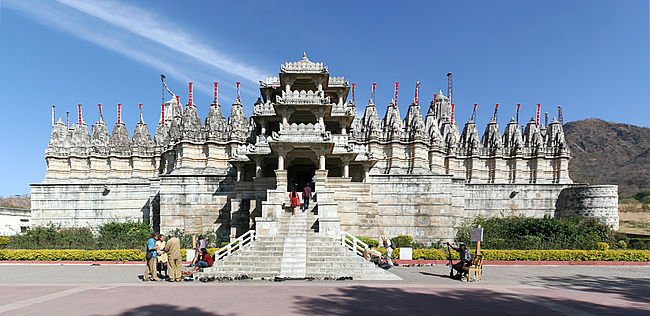
At 486 meters above the sea level  1444 carved white ivory columns, no two the same! No beggars or hawkers, just peace, friendly people and monkeys .
Ranakpur a 3 and a half hour drive from Jodhpur and 2 hours drive from Udaipur where the entire temple is made of white marble, 1444 columns with carvings so intricate, so fascinating that you can't imagine until you see it. The really amazing part is that no two are alike. You walk through the 24 pillared halls, each glistening with white marble that looks almost new - you can't even fathom that this place is nearly 600 years old.
It is also said that it is impossible to count the pillars. Also all the statues face one or the other statue. There is one beautiful carving made out of a single marble rock where there 108 heads of snakes and numerous tails. One cannot find the end of the tails. The image faces all four cardinal directions. In the axis of the main entrance, on the western side, is the largest image.The three other Jain temples in the same complex, including a temple of the Sun God. In the assembly hall, there are two big bells weighing 108 kgs whose sound echoes in the entire complex.The artistically carved nymphs playing the flute in various dance postures at a height of 45 feet are an engrossing sight.The dating of this temple is controversial but it is largely considered to be anywhere between the late 14th to mid-15th centuries.Inspired by a dream of a celestial vehicle, Dhanna Shah, a Porwad, is said to have commissioned it, under the patronage of Rana Kumbha, then ruler of Mewar.

This is truly one of the most amazing archaeological marvels.how they could carve the fantastic carvings of the 80 different domes out of a single massive piece of marble and lift it up there. Think - even one tiny mistake as they are chiseling out these carvings, and they would have to start all over. What really stuns you is that each room seems more beautiful than the last.

Saturday, June 18, 2011

The Kumbhalgarh Fort

                                                      
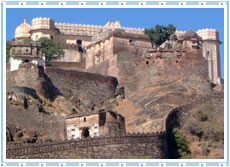
Kumbhalgarh Fort was built  in the 15th century in Rana Kumbha's time, the kingdom of Mewar spread from Ranthambore to Gwalior, including vast tracts of present-day Rajasthan and Madhya Pradesh. Mewar's rulers became patrons of all that was best in Indian martial and fine arts, architecture, and learning. Of the 84 fortresses defending Mewar, 32 were designed and built by Rana Kumbha. Of these, Kumbhalgarh encircled by thirteen elevated mountain peaks, the fort is constructed on the top most ridges around 1,914 meters above sea level with its36-kilometer long wall and soaring towers is the most impressive. It is stated to be the second longest wall in the world, the first being ''the Great Wall of China''. The huge complex of the Fort has numerous palaces, temples and gardens making it more magnificent.
                                                                 Kumbhalgarh Fort Rajasthan


 Kumbhalgarh stands on the site of an ancient citadel dating back to the second century AD belonging to a Jain descendant of India's Mauryan emperors. It defined the boundaries between Mewar and Marwar and became a refuge for Mewar's rulers in times of strife. Its steel gray ramparts encircle the fertile Shero Mallah Valley, with ancient monuments cenotaphs, ponds and flourishing farms. Kumbhalgarh fell only once in its history, to the combined forces of Emperor Akbar, Raja Man Singh of Amber, and Raja Udai Singh of Amber, and Raja Udai Singh of Marwar.
                                                                                     
The impregnable Fort boasts of seven massive gates, Hulla Pol, Hanuman Pol, Ram Pol, Bhairava Pol, Paghra Pol, Top-khana Pol and Nimboo Pol . seven ramparts folded with one another with designed walls toughened by curved bastions and huge watch towers. The strong structure and solid foundation of the Fort made it unbeatable till date. The hefty walls of the fort are broad enough to stand eight horses side by side. There are not less than 360 temples inside the complex of the Fort.The Fort is also known for its famous palace that resides on the top of structure. This beautiful palace is known as 'Badal Mahal' or the Palace of Cloud. It is also accredited to be the birth place of great warrior Maharana Pratap. This palace has beautiful rooms with lovely color combination of green, turquoise and white presenting a bright contrast to the earthy colors of the Fort. This place gives the appearance of being wandering in the world of clouds.
In the late 19th century, Rana Fateh Singh once again took the initiative to rebuild this remarkable palace. In the times of dissension, the fort also offered refuge to the rulers of Mewar. Even, the baby king Udai Singh was kept here safe during the time of battles. The large complex of the Fort which is 90 kilometers south of Udaipur offers ancient remnants to explore ..